- News
- June 17, 2026
David Rumsey - Winner of the 2026 IMCOS/Helen Wallis Award
In 2026, David Rumsey received the IMCoS Helen Wallis Award for contributions to the field of cartography worldwide. The following citation is reprinted from the IMCOS Map Journal, June 2026, No. 185.
Citation by Peter Barber
|
|
|
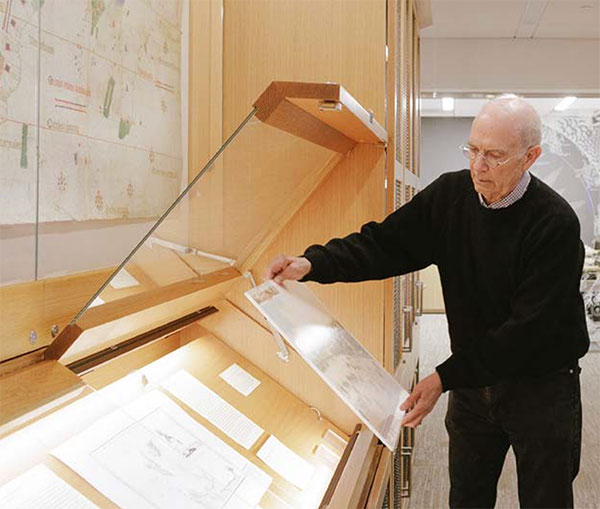
David Rumsey, winner of the 2026 IMCoS/Helen Wallis award, at work at the Map Center that bears his name and which this year celebrates its 10th anniversary. © Micaela Go/Stanford University Libraries.
|
The recipient of this year’s IMCoS/Helen Wallis award is not only a perspicacious map collector, with a precocious grasp of the significance of hitherto generally disregarded examples, and the creator of one of the world’s greatest, initially private, map collections. He is also one of the most munificent living cartographic philanthropists, inspired innovators in the techniques of map digitisation and generous enablers of history of cartography scholarship throughout the world.
He obtained a master’s degree in fine arts from Yale University and worked there as a lecturer in fine art, specialising in electronic technologies, before embarking on a highly successful 20-year career in real estate on the East Coast of the USA. He began collecting maps, initially relating to the Americas, in the early 1980s, long before moving to the West Coast and settling in southern California. He first concentrated on nineteenth- and twentieth-century maps at a time when few were interested in them. He acquired these comprehensively, not shying away from collecting enormous, multi-sheet series. He also moved into more conventional – and expensive – areas. He purchased examples of almost all the significant single sheet maps, multi-sheet wall maps, atlases, travel accounts, maritime charts and globes, dating from the dawn of printing to the present day. Today the collection is encyclopaedic, including more than 150,000 items and still growing: so much so that dealers have been mentioning that maps they are selling are not in his collection as an indication of rarity! Not the least of his achievements has been to ensure that all the maps in his collection get catalogued to the highest, internationally accepted, standards.
But the personal satisfaction that every collector gets from his collection has not been enough for him. From the first, visitors to his house, wishing to look at his maps have been made welcome. He was happy to discuss carto-bibliographical details over the phone and more recently via Zoom with fellow-enthusiasts – who left impressed at the depth of his knowledge. Before long, taking advantage of the latest technology and his own mastery of the medium, he decided to make his collections freely available to the world. From his home he supervised their digitisation in the most expert manner possible, to ensure that they were as close as possible in all respects to the originals and that the smallest details could be clearly seen. He also allowed high resolution images to be downloaded free of charge. In the process he pioneered digitisation techniques that have since set the international standard and have have been copied by libraries, public as well as private, throughout the world. The process of digitisation is ongoing, with over 120,000 maps from his total collection digitised to date, and more being added monthly. His action in sharing his collections digitally has proved over the decades to be an enormous boon: not only for collectors in all corners of the globe but also to scholars – whether or not they are researching the history of cartography.
In 2016 he decided to secure the long-term future of his collection by gifting it to Stanford University together with an endowment, thereby creating a Map Center bearing his name. This provides classroom instruction in the field, and the chance for the public to inspect the maps in person in the elegant surroundings of the Bing Wing of the Green Library. The Center also organises digital exhibitions, conferences, talks and other events. It is perhaps the greatest publicly available centre for the study of historic maps on the West Coast. In doing what he has, in the words of another leading map collector, he ‘has inspired students, collectors, and researchers, the world over to love maps and learn from them’.
But his generosity in making his collection and the related records available to scholars is only a part of his contribution to our field. Behind the scenes he has made significant donations to scholarly institutions and has helped to underwrite scholarly projects in the map history field being undertaken by universities and libraries not only in the USA but throughout the world, including the United Kingdom. To give only one example: he contributed substantially to the digitisation by the National Library of Scotland of almost all sheets of early Ordnance Survey maps at all scales.
I can think of no worthier recipient of this year’s IMCoS /Helen Wallis award than David Rumsey.